
Book Appointment Now
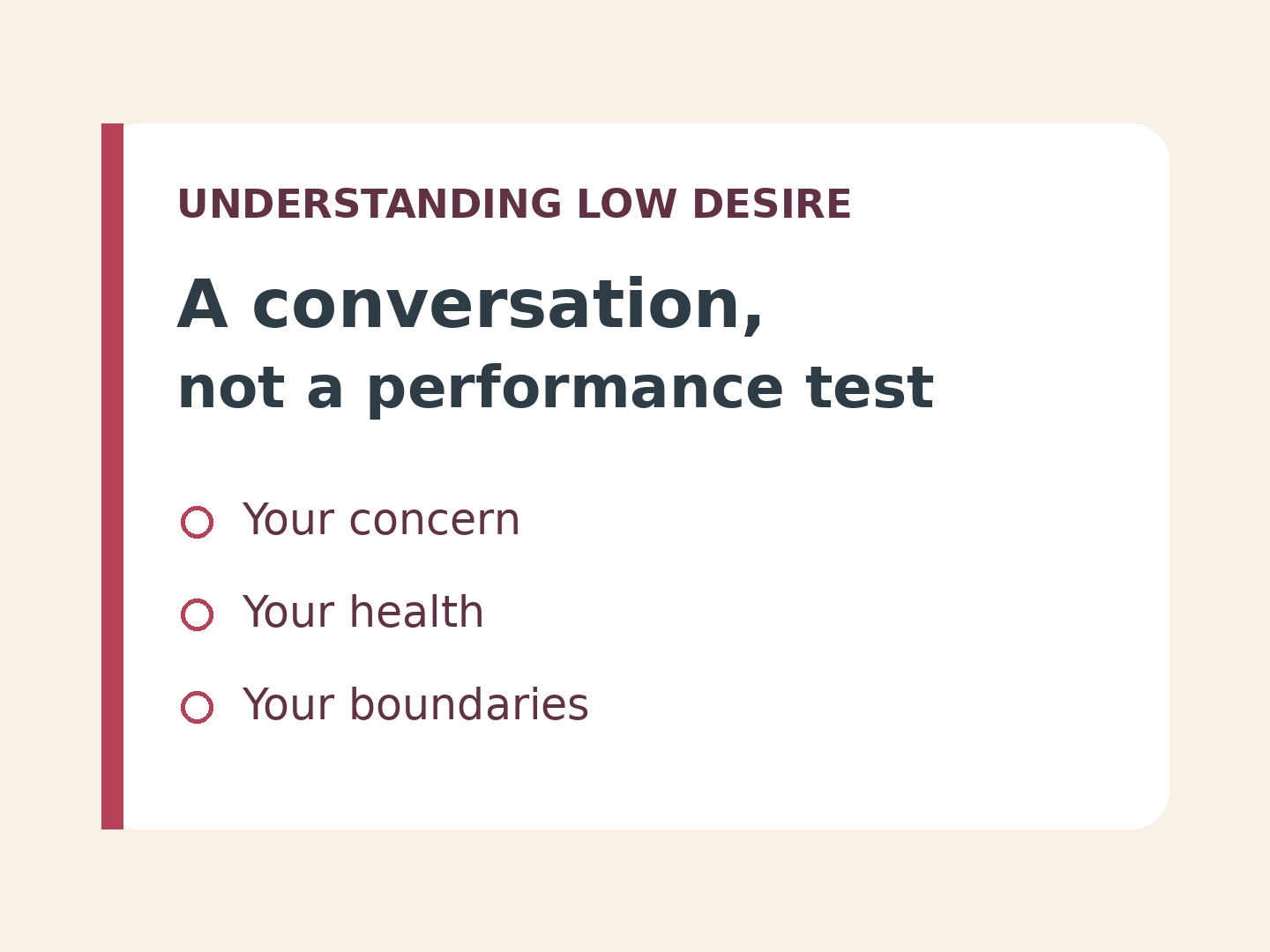
Low Sexual Desire Counseling in Nashik: Health, Consent and Conversation
Low sexual desire can be difficult to talk about, especially when you are unsure whether the change is about health, stress, your relationship, or your own expectations. You do not need to arrive at a consultation with a diagnosis. You can start with a clear description of what has changed, what concerns you, and what kind of support you want.
This guide is for adults considering low sexual desire counseling in Nashik. It explains how to separate a change in desire from a label, prepare for a medical review, discuss different levels of interest without pressure, and ask practical questions before choosing a service. It is not a test of your sexual performance and does not recommend a medicine, supplement, hormone, or exercise programme.
Quick answer: start with the concern, not a diagnosis
If a change in sexual desire worries you, speak with an appropriately qualified healthcare professional. The NHS lists several possible contributors, including relationship difficulties, stress, anxiety or depression, certain medicines, hormonal changes and some long-term health conditions. These are possibilities to assess, not explanations you can confirm from a checklist.
Counseling may be relevant when communication or relationship concerns are involved. Medical assessment matters too, because physical health and medicines can also play a role. Do not stop prescribed treatment or start a product advertised as a libido booster because of something you read online. Your next step should fit your own concern, rather than someone else’s preferred frequency of sex.
What do we mean by sexual desire?
Sex Therapy London, an NHS sexual health service, describes sexual desire as interest in and motivation for sexual activity. It explains that desire can rise and fall over life and that there is no single “normal” level. That distinction matters when an online article makes a particular amount of interest sound compulsory.
For a consultation, use your own words. You might say, “My interest has changed and I am upset about it,” or, “My partner and I want different things, and we need help talking.” Neither sentence requires you to decide whether you have a disorder. A clinician can consider the details rather than beginning with a label you found in an advertisement.
A difference between partners is not a verdict on either person
The International Society for Sexual Medicine, or ISSM, uses the term sexual desire discrepancy when one partner experiences more sexual interest than the other. This describes a difference between people. It should not become an accusation that one partner is defective, selfish, or responsible for keeping the other satisfied.
ISSM recommends open discussion of desires, concerns and boundaries, with professional help if the difference remains a problem. It also makes consent explicit: a person who does not want sex should not feel pressured, regardless of the circumstances. There is no requirement to agree to sexual activity as a compromise. Support should help both people communicate, not assign either person a quota.
Separate your own concern from outside expectations
Before booking, write down who is concerned and why. Are you personally distressed by a change? Are you experiencing discomfort? Are arguments making the topic hard to discuss? Or are you mainly worried because social media suggests you should want sex more often? These questions are a way to explain your situation, not a home diagnostic tool.
Sex Therapy London notes that some people rarely or never experience sexual desire and that, for some, this may relate to being asexual. Do not assume that a person’s identity or low interest needs to be “fixed.” If you seek help, describe what you want support with and what you do not want changed. Your own goals deserve to be heard.
Possible contributors are a starting point for assessment
The NHS lists relationship problems, stress, anxiety or depression, erectile difficulties or vaginal dryness, pregnancy and caring for a baby, menopause-related hormonal changes, certain medicines, hormonal contraception and excessive alcohol among possible contributors. Some long-term conditions can also affect desire. More than one issue may be relevant to the same person.
Listing these factors does not establish their importance in your case. A change during a stressful period does not prove that stress is the only explanation. Similarly, low interest alone does not establish a hormone deficiency. Share the timeline and any other symptoms with the professional assessing you. Ask what needs medical review and what can be discussed within counseling.
Keep medical assessment in the plan
Sex Therapy London advises assessment by an appropriately trained medical professional to understand the role of physical or medical factors in difficulties with desire and enjoyment. The NHS advises seeing a GP if you are worried about low sex drive, if you think medicine or hormonal contraception is affecting it, or if desire does not return to normal after pregnancy.
In Nashik, discuss these concerns with a qualified local medical practitioner who can assess you or refer you appropriately. Ask the counseling service how it handles a concern that needs medical assessment. Do not assume that the words “counseling” or “sexologist” alone tell you the provider’s qualification, prescribing authority, or scope of practice. Verify those details directly.
Prepare a timeline rather than a performance score
A short timeline can help you explain the change without having to remember every detail during a conversation. Note approximately when you first noticed it, whether it has been continuous or variable, and what else was happening around that time. Include uncertainty honestly. An approximate date is better than inventing a precise one.
You can also note whether your concern is about interest, enjoyment, discomfort, erections, ejaculation, relationship tension, or something else. These are different descriptions, even when they overlap. This preparation is an optional communication aid, not a validated assessment or a demand to monitor every sexual experience. Bring only the detail you want to discuss and ask the professional what further information is relevant.
Bring your medicine list, but do not change treatment yourself
The NHS identifies some medicines, including certain blood pressure medicines and antidepressants, as possible contributors to low desire. It also mentions hormonal contraception. If you suspect a connection, tell the prescribing clinician when the medicine started or changed and when you noticed the concern. A possible association still needs review.
Do not skip doses, stop contraception, reduce an antidepressant, or replace prescribed care with a supplement on the basis of this article. Ask the clinician who manages the treatment about the concern and available options. For the appointment, write down prescription medicines, non-prescription products and supplements you use. Do not treat a product’s “natural” description as proof that it suits you.
Open a conversation without blame or an obligation
ISSM recommends honest, non-judgmental discussion of desires and boundaries. A practical opening might be: “I want us to understand what each of us is experiencing, without deciding that either person is wrong.” Another is: “I would like help talking about this, but I do not want pressure to agree to sex.” These are sample phrases, not instructions that every couple must use.
Make room for a pause or a separate conversation. A partner’s answer may be different from your interpretation of their feelings. Ask what they want to share rather than presenting your explanation as fact. Agreement to talk is not agreement to sexual activity, and attending counseling together does not remove either person’s right to say no.
Decide what you want to discuss privately
You do not have to settle every detail of a joint discussion before asking a service about appointments. Ask whether an initial individual discussion is available, whether partners can attend together, and how the provider handles information shared separately. These are questions to confirm, not a statement that every clinic follows the same process.
Privacy should also be explained in concrete terms. Ask who can access notes, how appointment reminders are sent, what appears on receipts, and what confidentiality limits apply. Do not rely on a website’s absolute privacy claim as a complete explanation of its policy. If you prefer a particular contact method, tell the service and confirm whether it can follow that preference.
What can counseling address, and where are its limits?
The NHS lists relationship counseling as one possible approach when relationship problems contribute to low desire. ISSM suggests a therapist or counselor experienced in sexual issues or couples therapy when desire discrepancy remains a concern. The appropriate plan depends on the situation; these sources do not establish one fixed course for every person.
Counseling is not a substitute for assessing a possible medicine effect or physical health problem. It also should not be sold as a guaranteed way to make one person match another’s desire. Ask what the proposed support is intended to address, what is outside the provider’s scope, and when a medical referral is appropriate. Be cautious about promises of a cure within a set number of sessions.
Choose goals that belong to you
A useful question for an initial discussion is, “What would I like to understand or handle differently?” Your answer might be clearer communication, understanding a change, getting a medical review, or reducing pressure around the subject. These are possible discussion goals, not a prediction of what counseling will achieve.
If you attend as a couple, each person can state a goal separately. “I want us to talk without blame” and “I want my boundaries respected” can sit alongside a request to explore a change in interest. Do not turn improvement into a required frequency, a comparison with friends, or proof of love. Ask the professional how goals will be agreed and reviewed.
Questions to ask a counseling service in Nashik
City Sex Counselling and Therapy Center’s own website describes support for sexual health and relationship concerns and lists online and in-clinic appointments. That is the clinic’s description, not independent verification of an individual practitioner’s qualifications, availability, privacy policy or outcomes. Confirm the details relevant to your appointment directly before committing.
- Who would I see, and what are their qualifications and professional registration, where applicable?
- Do they work with concerns about desire, and what is within their scope?
- When would they suggest a medical assessment or another referral?
- Can I attend individually, and how is partner involvement handled?
- What are the fee, session length, cancellation terms and current appointment options?
- How are notes, reminders and confidentiality limits explained?
You can ask for clarification without accepting a package or a treatment recommendation immediately. This article does not verify current prices, appointment slots, languages or a particular therapy offered by the clinic.
An optional one-page note for your first discussion
If writing makes the conversation easier, bring a short note with these headings: what changed; approximately when; what worries me; other symptoms or discomfort; medicines and supplements; relevant health changes; relationship concerns I want to discuss; and questions for the professional. Leave sections blank if they do not apply.
Add your boundaries and preferred next step. For example: “I want a medical review before considering treatment,” or, “I want an individual discussion before deciding about joint sessions.” This is not a screening score and cannot tell you the cause. Its purpose is simply to help you explain your concern. Ask the provider how any written information you hand over will be stored.
Frequently asked questions
Does low desire automatically mean I have HSDD?
No. Do not use a general change in interest as a self-diagnosis. The sources above describe different possible contributors and variation in desire. A qualified professional can assess your concern, including whether a diagnosis is appropriate. An online article cannot make that decision from your level of interest alone.
Should I stop a medicine if I think it affects my desire?
No. Discuss the concern with the prescribing clinician and continue prescribed treatment unless that clinician advises a change. Explain the timing and bring your medicine list. The NHS advises seeking medical advice when you think a medicine or hormonal contraception may be affecting your sex drive.
Must my partner attend counseling with me?
Ask the service about its individual and joint appointment options. Do not assume attendance rules from a general article. You can explain that you want to discuss a concern privately first and ask how partner involvement, consent and separately shared information would be handled.
Does a difference in desire mean I should agree to sex more often?
No. ISSM explicitly says a person who does not want sex should not feel pressured. A discussion about different levels of interest should respect each person’s boundaries. Neither a relationship nor an appointment creates an obligation to take part in sexual activity.
Is there a guaranteed number of counseling sessions?
This guide cannot promise a session count or an outcome. Ask what the professional proposes after assessment, what the plan is intended to address, and how it will be reviewed. A medical concern may need a different route or a referral rather than counseling alone.
General information for adults, not personalised medical advice or a diagnosis. Do not change prescribed care because of this article. Source references are educational and do not imply endorsement of this clinic by the NHS or ISSM.
Sources: NHS: Low sex drive; Sex Therapy London NHS: Understanding sexual desire and enjoyment; ISSM: Sexual desire discrepancy; City Sex Counselling and Therapy Center website.